From Flock to Frock The Journey from Merino Wool to Scottish-Made Clothing
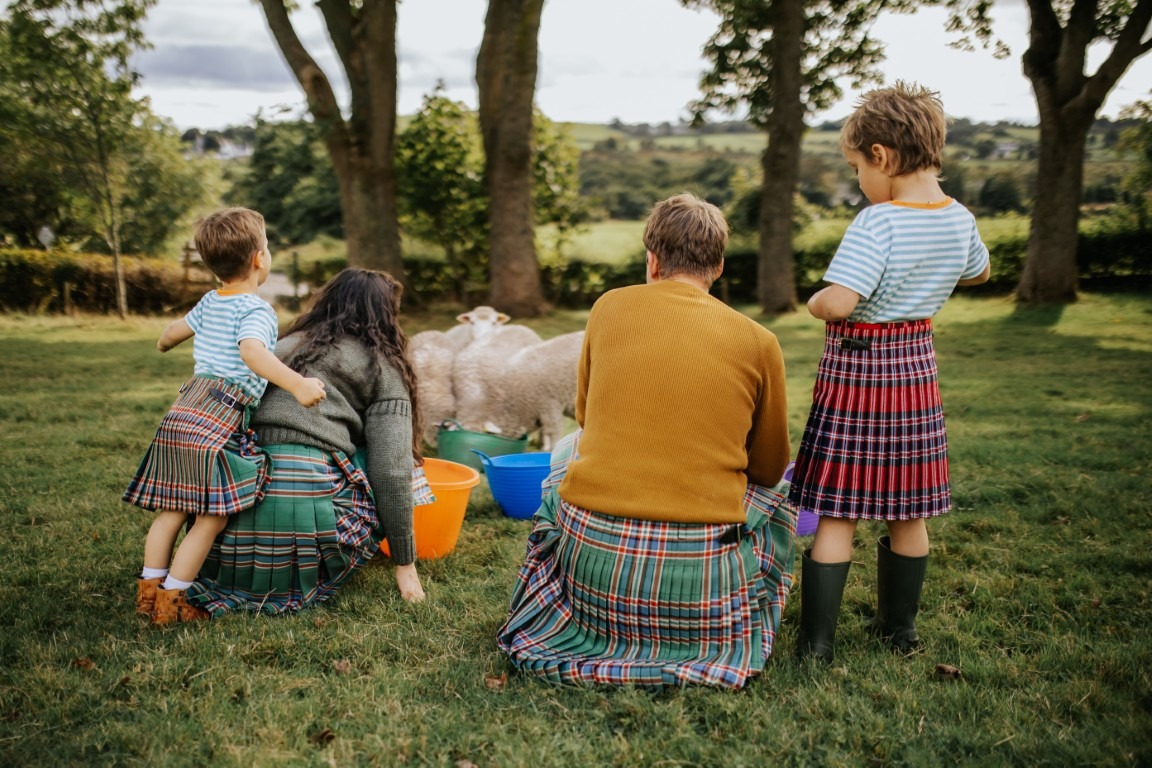
The idea for Flock to Frock started with the fabric I already use to make my tartan dresses here in the Scottish Highlands.
At Thistle and Cloth, I work with beautiful Merino wool cloth from Lochcarron of Scotland. I love working with it — the weight, the handle, the way it holds its shape and, of course, the fact that it is made here in Scotland.
But the more I worked with the cloth, the more curious I became about what came before it. Where does the fleece begin? What happens between a sheep being shorn and a finished piece of Scottish wool cloth arriving on my cutting table?
That is where the idea for Flock to Frock came from. A woolly rabbit hole has been opened and, as these things tend to do, the idea has already started becoming a reality.
I already have the beginnings of my little Merino flock, from Balmerino down near Dundee, and they are settling into life here in Sutherland. Among them are two of the boys — Ragnar and Floqui. You can probably see the Viking theme here…
For now, they are simply sheep doing sheep things (and some not-so-sheepy things!), getting to know their new surroundings and growing their fleeces.
But they are also the starting point for a much bigger experiment: seeing whether I can take the fleece from my own Merino sheep through the Scottish textile process and eventually turn it into clothes.
It’s a long way from a sheep in a field to a finished dress, and I have a lot to learn.
But that’s exactly what interests me.
Starting with Merino wool
Merino wool already has a place in my work because of the cloth I use from Lochcarron. So when I started thinking about keeping my own sheep, Merino felt like a natural place to start.
Merino is known for its fine, soft fleece, which makes it particularly suited to clothing.
But before I start thinking about dresses, there are sheep to look after, and they are now part of the family!
The wool is a product of keeping the sheep, not the other way around. Their health and welfare will always be the priority, and shearing will be an important part of their care.
Then I’ll have the fleece.
And that’s where the really interesting part begins.
From Merino fleece to Scottish wool cloth
One of the things I’m discovering already is just how much has to happen between a sheep being shorn and a piece of cloth arriving on the cutting table.
It’s easy to think of it as:
Sheep → fleece → yarn → cloth → garment
There are quite a few steps in between.
After shearing, the fleece needs to be skirted and sorted, removing the less useful parts and separating the wool according to quality.
It then needs to be scoured, essentially washing the fleece to remove dirt, natural grease and other material.
Then comes carding.
Carding teases apart the fibres and begins to align them, turning the washed fleece into an organised mass of fibre that can be prepared for spinning.
Depending on the route we take, particularly if we’re aiming for a fine, smooth Merino cloth, there may then be further processes such as combing and drawing. These progressively straighten and align the fibres and prepare them for spinning into a consistent yarn.
The fibres are then spun into yarn, and the yarn may be plied to give it the strength and character needed for the finished cloth.
Only then do we get to weaving.
And even after the cloth comes off the loom, it may still need finishing — washing, fulling, pressing, brushing or other processes to give it the final weight, handle and appearance.
Then, finally, I get to put a pair of scissors anywhere near it.
I’m already looking forward to that bit.
I’m used to starting with beautiful finished Merino cloth from Lochcarron and turning it into a dress. With Flock to Frock, I want to work backwards and understand everything that happens before the cloth reaches me.
Keeping the journey in Scotland
One of the biggest ambitions for Flock to Frock is to keep as much of the journey as possible here in Scotland.
If I’m going to start with sheep in the Highlands, I’d love to find Scottish people and businesses who can help take that fleece through the different stages — from scouring and carding through to spinning, weaving and finishing.
I know I may not be able to keep every single stage here.
This is going to be a learning process, and the right equipment and expertise aren’t necessarily on the doorstep. But I’d like to see how far I can bring the journey home.
Scotland has such a strong textile heritage, and there are still mills, spinners, weavers and makers carrying that knowledge forward.
I’d like to find them, learn from them and see whether this little flock can become part of that network.
The dream is to be able to follow the journey:
Scottish sheep.
Scottish fleece.
Scottish processing.
Scottish yarn.
Scottish cloth.
Scottish-made garments.
And eventually, hopefully, a dress.
A small part of the wool revival
There is a renewed interest in wool at the moment, and I’m really interested in being part of that.
Britain has an extraordinary wool heritage. Sheep farming, wool and textile making have shaped communities and landscapes for centuries, particularly here in Scotland.
But somewhere along the way, many of us became quite disconnected from the materials in our clothes.
We buy a jumper or a dress and rarely stop to think about where the fibre came from, who processed it or how many stages it went through before reaching the shop.
I think there is a growing desire to understand that again.
The wool revival isn’t about pretending we can go back to some imagined version of the past. For me, it’s about looking at a material that has been part of our landscape for generations and asking what we can do with it now.
Wool isn’t without environmental impact. Sheep farming has an impact, and processing fibre takes energy and resources. I don’t want to pretend otherwise.
But wool is a natural and renewable fibre, and a well-made wool garment can be worn for many years.
That fits much more closely with how I want to make clothes.
Make fewer.
Make them well.
Repair them when they need repairing.
And keep wearing them.
Reconnecting clothes with where they come from
One of the things I love about working with tartan is the sense of place that comes with it.
The cloth has a story before I ever cut into it.
That is what I’d like to create with Flock to Frock too.
I’d like to be able to look at a finished garment one day and know its story.
To know the sheep that produced the fleece.
To know where it was processed.
To know who spun it.
Who wove it.
And how it eventually became the cloth on my cutting table.
I’m not expecting to replace the beautiful Lochcarron cloth I already use. Quite the opposite.
It is the cloth I’ve been working with that has made me curious about the journey in the first place.
Lochcarron has shown me what beautiful Merino cloth can become.
Now I want to go back to the beginning and see how much of that journey I can bring home to the Highlands.
From sheep to dress won’t happen overnight
This isn’t going to happen overnight.
There are sheep to get to know, fleeces to learn about, mills to find, samples to make and probably plenty of things that don’t work the first time.
The first fleece might not become a dress.
It might become a sample.
Or a small piece of cloth that teaches me what to do differently next time.
And that’s okay.
I want to share the process rather than just the finished product — the good bits, the difficult bits and all the things I learn along the way.
For now, Ragnar and Floqui are just getting on with being sheep.
But they might just be the beginning of something quite special.
Flock to Frock is about reconnecting the clothes I make with the material they’re made from.
It starts here in Sutherland, in the Scottish Highlands, with a small flock of Merinos.
The aim is to take their fleece through as much of the process as possible here in Scotland.
And, eventually, to turn that fleece into cloth and that cloth into something I can wear.
A garment with a story that starts much further back than the cutting table.
From flock to fleece.
From fleece to yarn.
From yarn to cloth.
From cloth to frock.
That’s the plan.